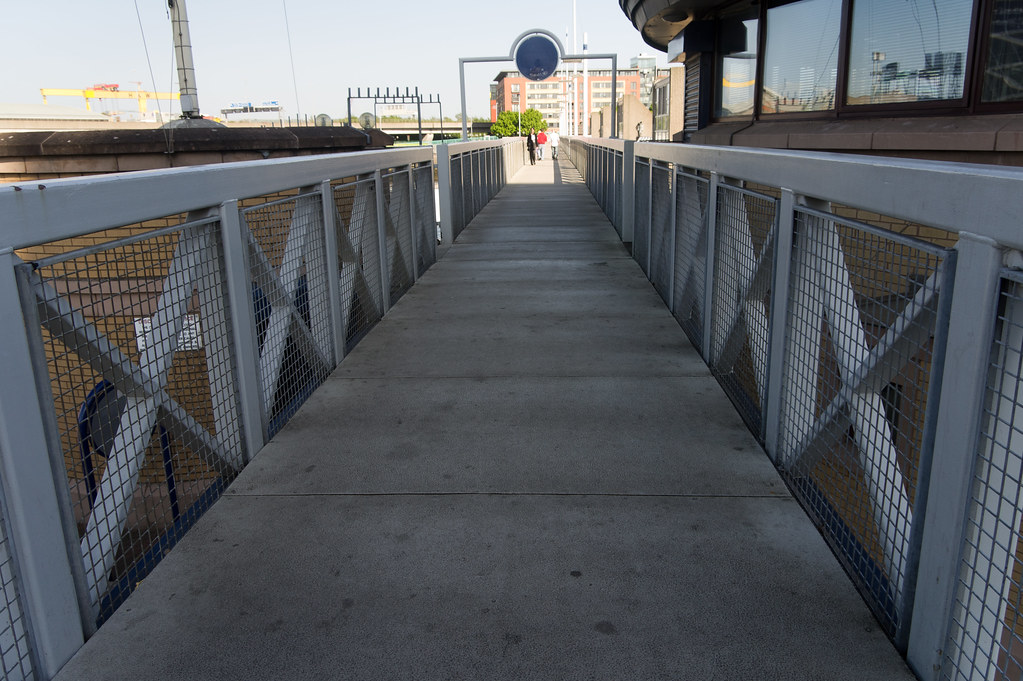
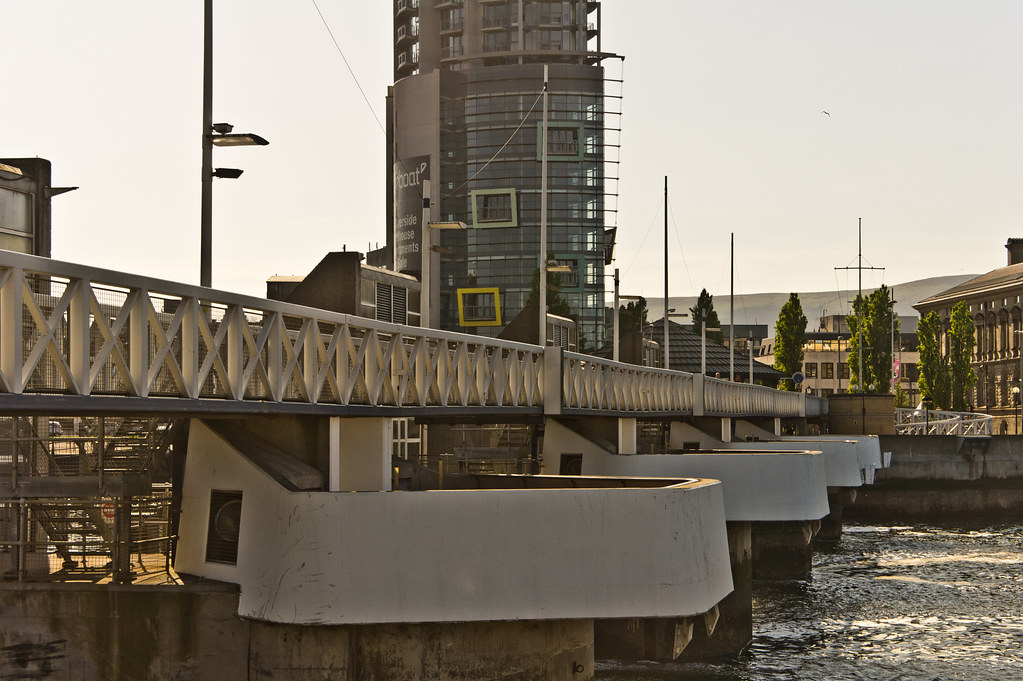
The new Lagan Weir Pedestrian and Cycle Bridge was officially opened on 30 June 2015. It was still under construction when I visited the city in 2015 but this year I got the opportunity to use and photograph it. I must admit that I was impressed.
The footbridge connects Donegal Quay with Queen’s Quay, replacing the rather unattractive old footbridge.
The new structure consists of structural steel, enveloped in aluminium cladding with a glass parapet on the east elevation and a stainless steel post and wire system on the west parapet.
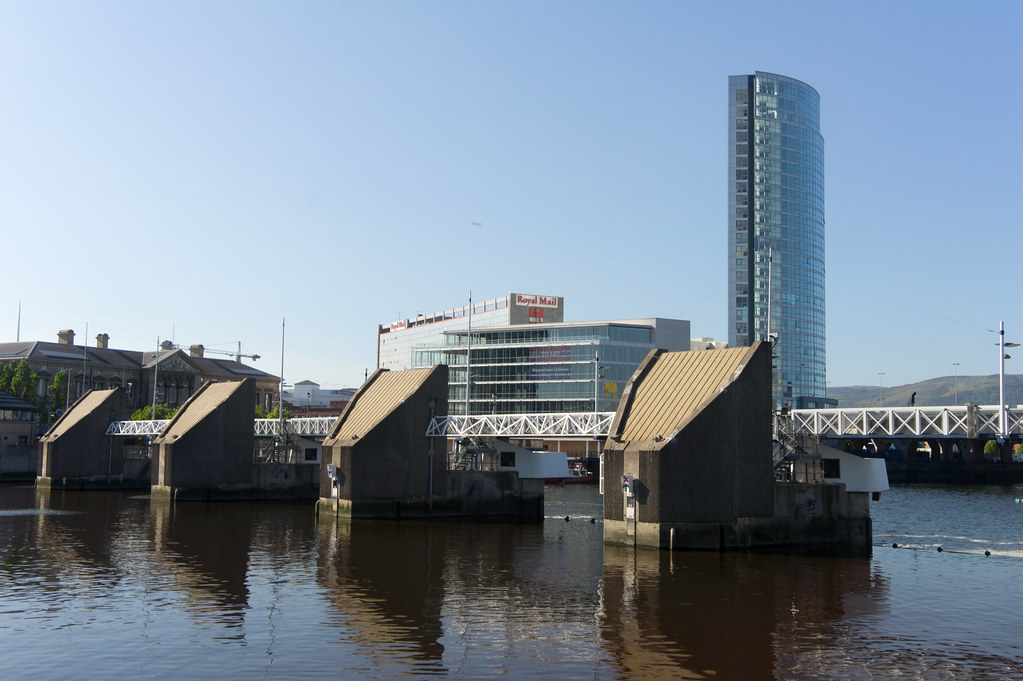
The Lagan Weir, completed in 1994, at a cost of £14m, is located across the Lagan between the Queen Elizabeth Bridge and the M3 bridge (completed around the same time) in Belfast, Northern Ireland.
The Lagan Weir was jointly funded by the Corporation and the European Commission. It was constructed by Charles Brand Ltd and designed by Ferguson and McIlveen.
The weir is a series of massive steel barriers which are raised as the tide retreats to keep the river at an artificially constant level. This improvement to the sewerage system combined with massive dredging of the river by mechanical excavators, and installation of an underwater aeration system, has led to a marked improvement in water quality and the environment around the river.
Lagan Weir, dredging and aeration have increased water quality in the river and salmon is returning. An otter and seals have followed the fish that now move up river to spawn in what was once an aquatic death trap.
The objective of the structure is to keep the level of the river artificially constant, as it is a tidal river the level of the water varied by up to three metres between high and low tide. This exposed mudflats which were unsightly and emitted a strong odour, particularly in the summer months.
The transformation of the riverside by the construction of the weir has been a catalyst for development along the riverside. Another part of the project is the “Lagan Lookout” centre which explains the history and function of the weir as well as the history of the Lagan itself.
![The New £5m Lagan Weir Footbridge In Belfast City [I Like It]-121101](https://c3.staticflickr.com/9/8148/29635100242_33762d8d73_b.jpg)
![The New £5m Lagan Weir Footbridge In Belfast City [I Like It]-121092](https://c5.staticflickr.com/9/8437/29455260980_7a8750e02c_b.jpg)
![The New £5m Lagan Weir Footbridge In Belfast City [I Like It]-121083](https://c2.staticflickr.com/9/8333/29121973873_dbee9354f4_b.jpg)
THE OLD FOOTBRIDGE:
![LAGAN RAILWAY PLUS PEDESTRIAN BRIDGE IN BELFAST [TWO FOR THE PRICE OF ONE]--121123](https://c4.staticflickr.com/9/8807/29168143163_4f2cbb40a4_b.jpg)
![LAGAN RAILWAY PLUS PEDESTRIAN BRIDGE IN BELFAST [TWO FOR THE PRICE OF ONE]--121122](https://c5.staticflickr.com/9/8245/29757783476_8d555a943e_b.jpg)
![LAGAN RAILWAY PLUS PEDESTRIAN BRIDGE IN BELFAST [TWO FOR THE PRICE OF ONE]--121121](https://c1.staticflickr.com/8/7475/29166040104_fb8dd521b6_b.jpg)
![LAGAN RAILWAY PLUS PEDESTRIAN BRIDGE IN BELFAST [TWO FOR THE PRICE OF ONE]--121120](https://c5.staticflickr.com/9/8050/29166033284_46f45b56bc_b.jpg)
![LAGAN RAILWAY PLUS PEDESTRIAN BRIDGE IN BELFAST [TWO FOR THE PRICE OF ONE]--121119](https://c7.staticflickr.com/9/8292/29166024454_770e892956_b.jpg)
![LAGAN RAILWAY PLUS PEDESTRIAN BRIDGE IN BELFAST [TWO FOR THE PRICE OF ONE]--121118](https://c3.staticflickr.com/9/8017/29757764746_4035150765_b.jpg)
![LAGAN RAILWAY PLUS PEDESTRIAN BRIDGE IN BELFAST [TWO FOR THE PRICE OF ONE]--121117](https://c3.staticflickr.com/9/8238/29757762786_7edbcf182e_b.jpg)
![LAGAN RAILWAY PLUS PEDESTRIAN BRIDGE IN BELFAST [TWO FOR THE PRICE OF ONE]--121116](https://c5.staticflickr.com/9/8245/29166013404_b8376e3e1f_b.jpg)

![THE BIG FISH NEAR THE LAGAN WEIR IN BELFAST [BY JOHN KINDNESS]-121120](https://c3.staticflickr.com/9/8231/29146607874_db2995d62e_b.jpg)
![THE BIG FISH NEAR THE LAGAN WEIR IN BELFAST [BY JOHN KINDNESS]-121119](https://c8.staticflickr.com/9/8071/29691797231_accc91ff87_b.jpg)
![THE BIG FISH NEAR THE LAGAN WEIR IN BELFAST [BY JOHN KINDNESS]-121118](https://c8.staticflickr.com/9/8327/29691793751_dfe6db8dfc_b.jpg)
![THE BIG FISH NEAR THE LAGAN WEIR IN BELFAST [BY JOHN KINDNESS]-121117](https://c2.staticflickr.com/9/8052/29691791281_353c2afcf7_b.jpg)
![THE BIG FISH NEAR THE LAGAN WEIR IN BELFAST [BY JOHN KINDNESS]-121116](https://c3.staticflickr.com/9/8556/29482168250_512654b149_b.jpg)
![THE WATERFRONT HALL IN BELFAST [WITH NEW EXTENSION]-121115](https://c4.staticflickr.com/9/8489/29667483211_631b8afd2a_b.jpg)
![THE WATERFRONT HALL IN BELFAST [WITH NEW EXTENSION]-121114](https://c4.staticflickr.com/9/8245/29124381043_03ea763f49_b.jpg)
![THE WATERFRONT HALL IN BELFAST [WITH NEW EXTENSION]-121113](https://c3.staticflickr.com/9/8859/29457628530_38f16f3b41_b.jpg)
![THE WATERFRONT HALL IN BELFAST [WITH NEW EXTENSION]-121102](https://c1.staticflickr.com/9/8049/29637442632_7529d5744b_b.jpg)
![RAMADA ENCORE HOTEL [15mm LENS USED WITH SONY A7RM2]-124](https://c3.staticflickr.com/8/7563/29450852450_eb151dc513_b.jpg)
![RAMADA ENCORE HOTEL [ST. ANNES SQUARE AREA OF BELFAST]-123](https://c6.staticflickr.com/9/8548/29660688501_871f69dc55_b.jpg)
![RAMADA ENCORE HOTEL [ST. ANNES SQUARE AREA OF BELFAST]-122](https://c5.staticflickr.com/9/8420/29706732156_6ce788ccbf_b.jpg)
![RAMADA ENCORE HOTEL [ST. ANNES SQUARE AREA OF BELFAST]-121](https://c1.staticflickr.com/9/8544/29706726536_c5098127cf_b.jpg)
![TRANSPORT HOUSE IN BELFAST [THE UGLY HOARDING HAS EVENTUALLY BEEN REPLACED BUT ON THE CHEAP]-121000](https://c8.staticflickr.com/9/8486/29112387343_7ed36325fc_b.jpg)
![TRANSPORT HOUSE IN BELFAST [THE UGLY HOARDING HAS EVENTUALLY BEEN REPLACED BUT ON THE CHEAP]-120999](https://c8.staticflickr.com/8/7551/29655699151_b8cbe12733_b.jpg)
![TRANSPORT HOUSE IN BELFAST [THE UGLY HOARDING HAS EVENTUALLY BEEN REPLACED BUT ON THE CHEAP]-120998](https://c1.staticflickr.com/9/8379/29625717712_b9c8fe9153_b.jpg)
![TRANSPORT HOUSE IN BELFAST [THE UGLY HOARDING HAS EVENTUALLY BEEN REPLACED BUT ON THE CHEAP]-120997](https://c8.staticflickr.com/9/8856/29112379383_92befa1804_b.jpg)
![TRANSPORT HOUSE IN BELFAST [THE UGLY HOARDING HAS EVENTUALLY BEEN REPLACED BUT ON THE CHEAP]-120992](https://c8.staticflickr.com/9/8455/29112236663_7e6ec26586_b.jpg)