Monday, September 19, 2016

RNLB WINDSOR RUNNER - CIVIL SERVICE NO.42 [A VISIT TO THE TITANIC QUARTER IN BELFAST]

This is a “relief lifeboat” and I have no idea what that actually means.

The Trent-class lifeboat is an all-weather lifeboat operated by the Royal National Lifeboat Institution (RNLI) from 30 stations around the coasts of Great Britain and Ireland to provide coverage up to 50 miles (80 km) out to sea. Introduced to service in 1994, the class is named after the River Trent, the second longest river wholly in England.

Windsor Runner (Civil Service No 42) was so named to commemorate the fundraising success of the twelve half marathon races held at Windsor Great Park each year up to 1995. This Trent-class lifeboat was stationed at Blyth, Northumberland, and went into service on 1 December 1995. She was purchased at a cost to The Fund of £693,698.

This boat was originally based at Blyth Lifeboat Station.

A lifeboat had first been based at Blyth in 1808, privately sponsored by Sir Matthew Ridley. This boat was wrecked on service in 1810 and was not replaced. In 1826 the Port of Newcastle Shipwreck Association funded a new Blyth lifeboat and in 1866 the RNLI took over the running of the station. In 1920, for the station's first motor lifeboat, the RNLI built a new boathouse and slipway which, with modifications over the years, is still in use for the "D" class inflatable today. The various motor lifeboats over the years were slipway launched until October 1982 when a Waveney-class fast afloat boat was allocated to the station. The Waveney served until replaced by a new 25knot Trent-class boat in December 1995 (in fact, unusually, all of Blyth's motor lifeboats had been built new for the station). However, a review of lifeboat provision in the North East led to the decision to withdraw the all-weather lifeboat from Blyth, and the station became inshore only on July 16, 2004. Inevitably, decisions to close or downgrade stations often lead to local concerns and following the RNLI's decision the Blyth Volunteer Lifeboat Service was set up and purchased a 38-foot-6-inch Lochin lifeboat which had been built in 1990 for the Caister Volunteer Rescue Service (a body similarly set up after withdrawal of an RNLI all-weather boat). The boat, named Spirit of Blyth and Wansbeck, went into service in 2005.

RNLB WINDSOR RUNNER - CIVIL SERVICE NO.42 [A VISIT TO THE TITANIC QUARTER IN BELFAST]-121130 RNLB WINDSOR RUNNER - CIVIL SERVICE NO.42 [A VISIT TO THE TITANIC QUARTER IN BELFAST]-121129

LAGAN RAILWAY PLUS PEDESTRIAN BRIDGE IN BELFAST [TWO FOR THE PRICE OF ONE]

The railway bridge across the Lagan dates from the rebuilding of the Belfast Central line in 1974/76.

It replaced the old structure which was known locally as the “Shaky Bridge”. The older bridge was in use from 1884 to 1965 when the line was closed to accommodate the widened of Middlepath Street.

The current railway bridge carries trains to Derry, Larne and Bangor [correct me if I am wrong about this].

The footbridge is on the downstream side of the railway and it connects both sides of the Laganside Walkway.

LAGAN RAILWAY PLUS PEDESTRIAN BRIDGE IN BELFAST [TWO FOR THE PRICE OF ONE]--121123 LAGAN RAILWAY PLUS PEDESTRIAN BRIDGE IN BELFAST [TWO FOR THE PRICE OF ONE]--121122 LAGAN RAILWAY PLUS PEDESTRIAN BRIDGE IN BELFAST [TWO FOR THE PRICE OF ONE]--121121 LAGAN RAILWAY PLUS PEDESTRIAN BRIDGE IN BELFAST [TWO FOR THE PRICE OF ONE]--121120 LAGAN RAILWAY PLUS PEDESTRIAN BRIDGE IN BELFAST [TWO FOR THE PRICE OF ONE]--121119 LAGAN RAILWAY PLUS PEDESTRIAN BRIDGE IN BELFAST [TWO FOR THE PRICE OF ONE]--121118 LAGAN RAILWAY PLUS PEDESTRIAN BRIDGE IN BELFAST [TWO FOR THE PRICE OF ONE]--121117 LAGAN RAILWAY PLUS PEDESTRIAN BRIDGE IN BELFAST [TWO FOR THE PRICE OF ONE]--121116

Sunday, September 18, 2016

THE BIG FISH NEAR THE LAGAN WEIR IN BELFAST [BY JOHN KINDNESS]

The Big Fish also called the Bigfish is a printed ceramic mosaic sculpture by artist John Kindness. 10 metres long and constructed in 1999 it is located at Donegall Quay in Belfast, near the Lagan Lookout and Custom House. The outer skin of the fish is a cladding of ceramic tiles decorated with texts and images relating to the history of Belfast. Material from Tudor times to present day newspaper headlines are included along with contributions from Belfast school children. The Big Fish also contains a time capsule storing information/images/poetry relating to the City.
THE BIG FISH NEAR THE LAGAN WEIR IN BELFAST [BY JOHN KINDNESS]-121120 THE BIG FISH NEAR THE LAGAN WEIR IN BELFAST [BY JOHN KINDNESS]-121119 THE BIG FISH NEAR THE LAGAN WEIR IN BELFAST [BY JOHN KINDNESS]-121118 THE BIG FISH NEAR THE LAGAN WEIR IN BELFAST [BY JOHN KINDNESS]-121117 THE BIG FISH NEAR THE LAGAN WEIR IN BELFAST [BY JOHN KINDNESS]-121116

Saturday, September 17, 2016

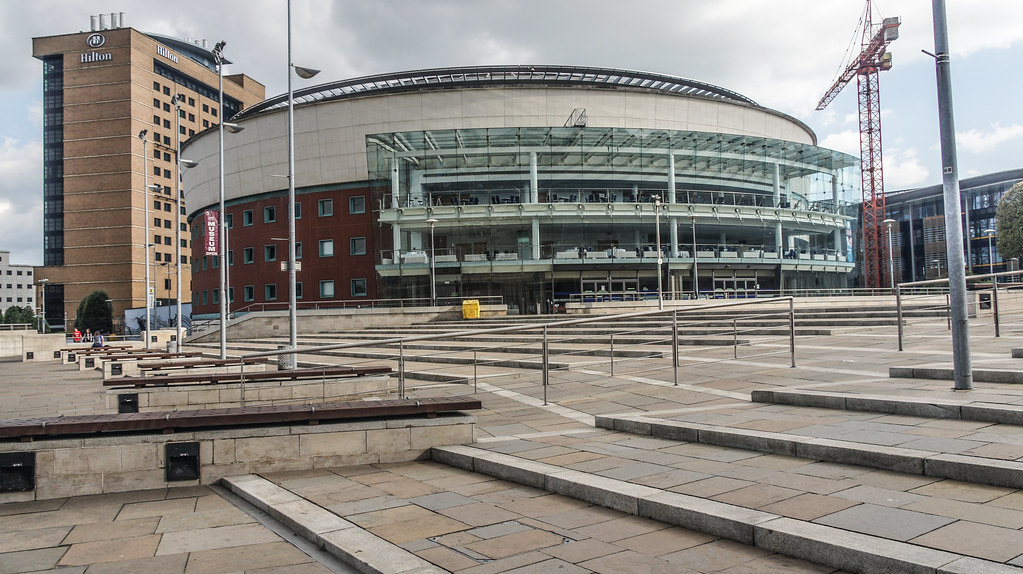
THE WATERFRONT HALL IN BELFAST [WITH NEW EXTENSION]

OK, I must admit that I had failed to notice that this building had been extended until I returned home from Belfast.

Robinson McIlwaine designed the original building but lost out to Todd Architects for a £29.5 extension. According to many in Belfast the extension - which has already attracted local nicknames such as the Box on the Docks and the Sore on the Shore [I am sure that there are some rude names] - is an ugly addition to the Belfast skyline.

Belfast Waterfront is a multi-purpose conference and entertainment centre, in Belfast, Northern Ireland, designed by local architects' firm Robinson McIlwaine. The hall is located in Lanyon Place, the flagship development of the Laganside Corporation.

The development is named after the architect Charles Lanyon. Planning for the building began 1989, with the hall being completed in 1997 for the sum of £32 million. The main circular Auditorium seats 2,241 and is based on the Berlin Philharmonic Hall designed by Hans Scharoun. However the flexible design of the Auditorium allows the stalls seating to be moved to create a larger arena.

The smaller adjoining Studio seats 380. The dome of the building is coated in copper. This is so the exterior will eventually turn green and reflect the dome of Belfast City Hall and other Victorian buildings in the city centre. The building also contains bars and a restaurant.
THE WATERFRONT HALL IN BELFAST [WITH NEW EXTENSION]-121115 THE WATERFRONT HALL IN BELFAST [WITH NEW EXTENSION]-121114 THE WATERFRONT HALL IN BELFAST [WITH NEW EXTENSION]-121113 THE WATERFRONT HALL IN BELFAST [WITH NEW EXTENSION]-121102
ORIGINAL - BEFORE EXTENSION WAS ADDED: The Waterfront Hall Belfast

The New £5m Lagan Weir Footbridge In Belfast City [I Like It]

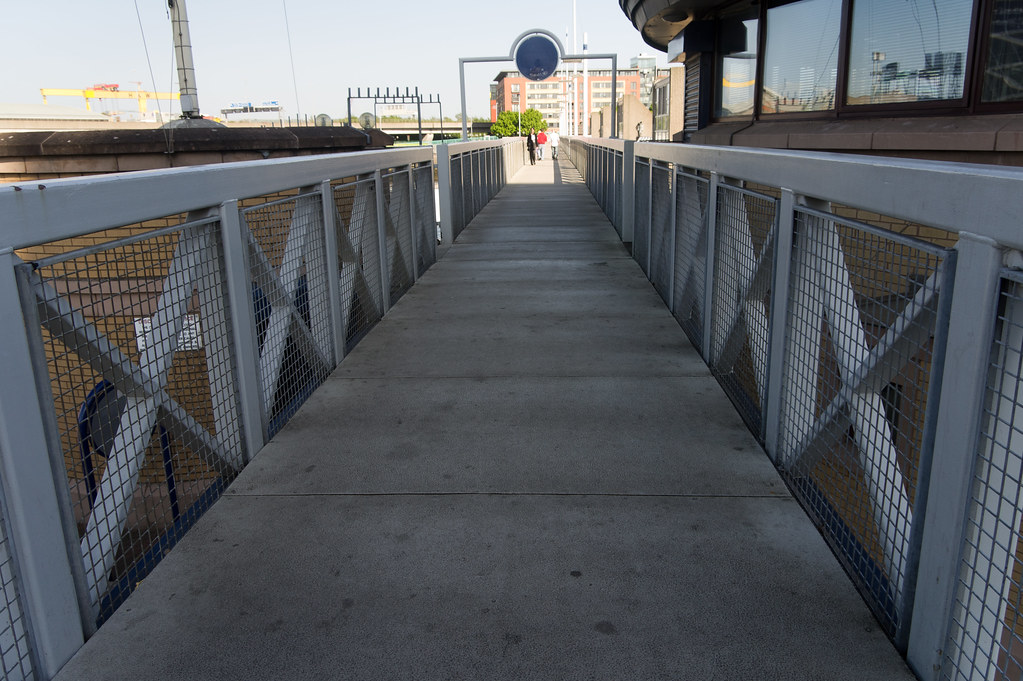
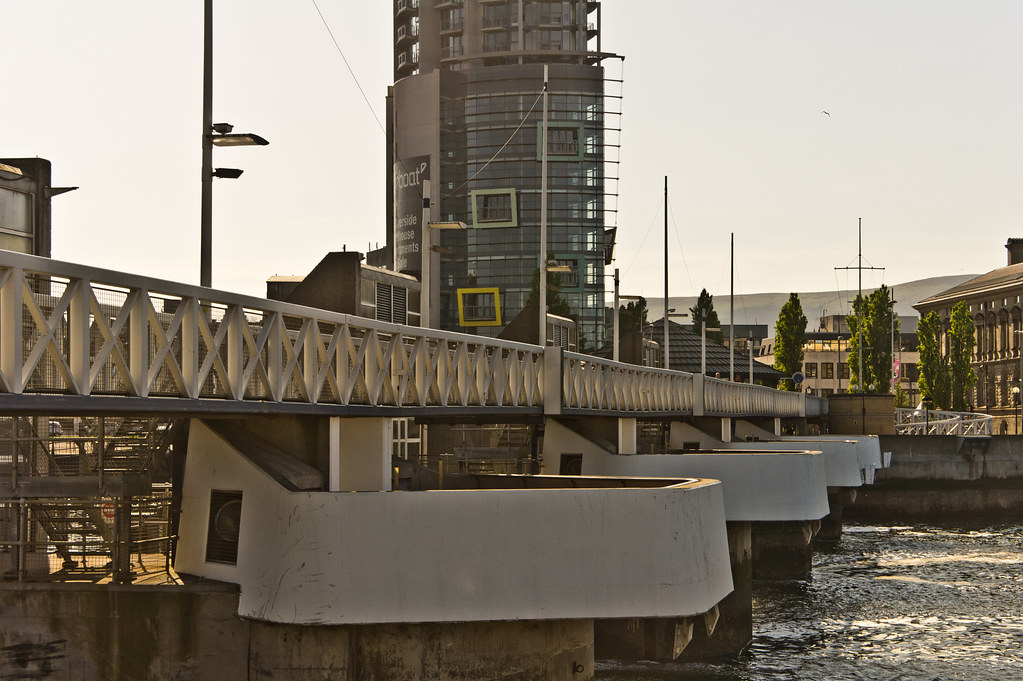
The new Lagan Weir Pedestrian and Cycle Bridge was officially opened on 30 June 2015. It was still under construction when I visited the city in 2015 but this year I got the opportunity to use and photograph it. I must admit that I was impressed.

The footbridge connects Donegal Quay with Queen’s Quay, replacing the rather unattractive old footbridge.

The new structure consists of structural steel, enveloped in aluminium cladding with a glass parapet on the east elevation and a stainless steel post and wire system on the west parapet.

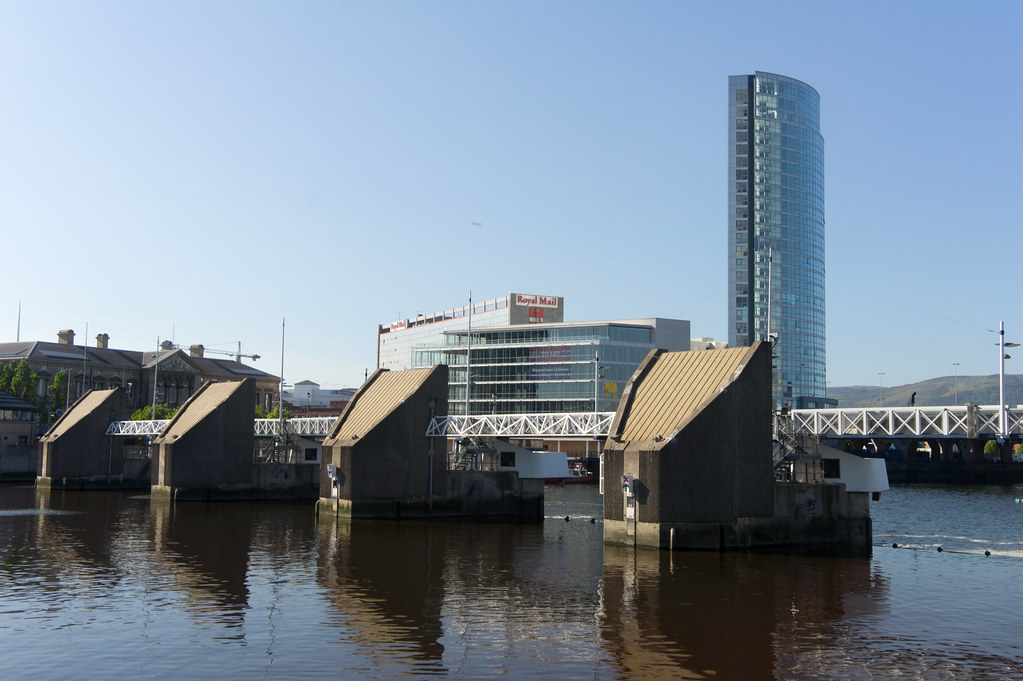
The Lagan Weir, completed in 1994, at a cost of £14m, is located across the Lagan between the Queen Elizabeth Bridge and the M3 bridge (completed around the same time) in Belfast, Northern Ireland.

The Lagan Weir was jointly funded by the Corporation and the European Commission. It was constructed by Charles Brand Ltd and designed by Ferguson and McIlveen.

The weir is a series of massive steel barriers which are raised as the tide retreats to keep the river at an artificially constant level. This improvement to the sewerage system combined with massive dredging of the river by mechanical excavators, and installation of an underwater aeration system, has led to a marked improvement in water quality and the environment around the river.

Lagan Weir, dredging and aeration have increased water quality in the river and salmon is returning. An otter and seals have followed the fish that now move up river to spawn in what was once an aquatic death trap. The objective of the structure is to keep the level of the river artificially constant, as it is a tidal river the level of the water varied by up to three metres between high and low tide. This exposed mudflats which were unsightly and emitted a strong odour, particularly in the summer months.

The transformation of the riverside by the construction of the weir has been a catalyst for development along the riverside. Another part of the project is the “Lagan Lookout” centre which explains the history and function of the weir as well as the history of the Lagan itself.
The New £5m Lagan Weir Footbridge In Belfast City [I Like It]-121101 The New £5m Lagan Weir Footbridge In Belfast City [I Like It]-121092 The New £5m Lagan Weir Footbridge In Belfast City [I Like It]-121083
THE OLD FOOTBRIDGE: The Lagan Weir, completed in 1994, at a cost of £14m The Lagan Weir, completed in 1994, at a cost of £14m The Lagan Weir, completed in 1994, at a cost of £14m

BELFAST BIKE DOCKING STATION AND OLD STYLE RED PHONE KIOSK [URBAN DECAY - NORTH STREET BELFAST]

This phone kiosk is an example of a 1936 K6 'Jubilee Box' and it is listed. 

This bike docking station is on North Street [across the road from Blinkers]. Maybe someone might be able to explain why there are so many weeds and grass growing between the footpath bricks.

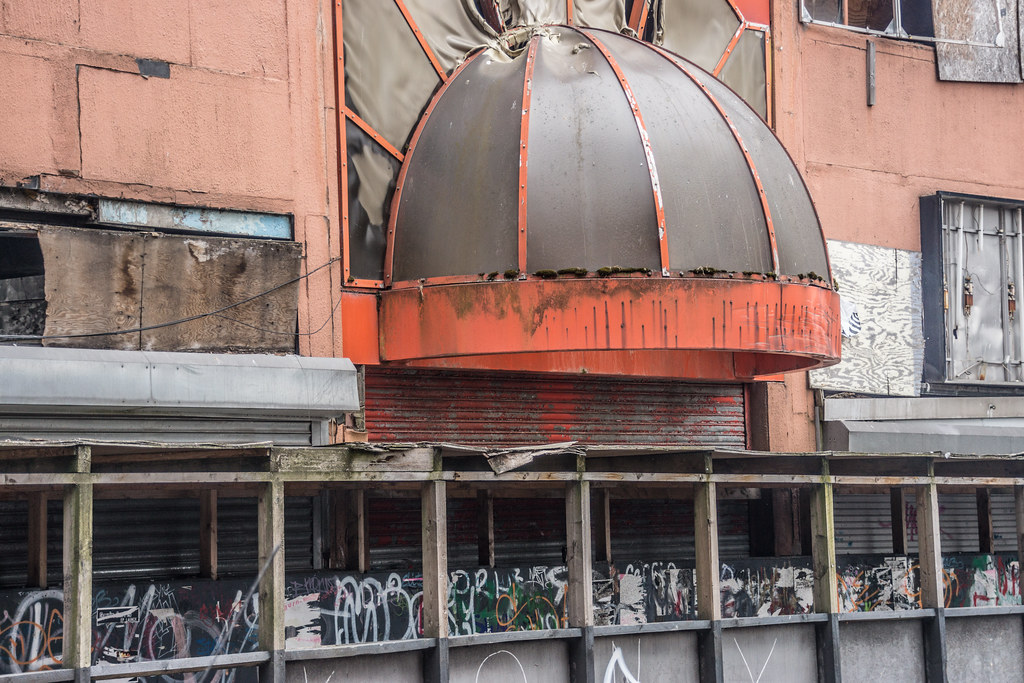
The phone kiosk is not in the best of condition either. Lower North Street which has been described as “the street that time passed by”. It was external to the security barriers during the bombing campaign and as such it was avoided by shopkeepers and customers alike. It has never recovered especially following destruction and neglect of the North Street Arcade by fire.

Coca-Cola Zero Belfast Bikes, commonly referred to as Belfast Bikes, is a public bicycle rental scheme which has operated in the city of Belfast since April 2015. At its launch, the scheme, which is sponsored by Coca-Cola HBC, used 300 Unisex bicycles with 30 stations The Department for Regional Development (DRD) is providing initial capital funding for the scheme as part of their Active Travel Demonstration Projects budget.

NSL is looking after the daily operation of the scheme, while Nextbike is responsible for the bikes. Initially there will be 30 docking stations and in the future it is hoped the scheme will be expanded beyond the city centre boundary. Options for expansion will depend on securing additional resources and council approval.


BELFAST BIKE DOCKING STATION AND OLD STYLE RED PHONE KIOSK [URBAN DECAY - NORTH STREET BELFAST]-121082 BELFAST BIKE DOCKING STATION AND OLD STYLE RED PHONE KIOSK [URBAN DECAY - NORTH STREET BELFAST]-121081 BELFAST BIKE DOCKING STATION AND OLD STYLE RED PHONE KIOSK [URBAN DECAY - NORTH STREET BELFAST]-121080 BELFAST BIKE DOCKING STATION AND OLD STYLE RED PHONE KIOSK [URBAN DECAY - NORTH STREET BELFAST]-121079 BELFAST BIKE DOCKING STATION AND OLD STYLE RED PHONE KIOSK [URBAN DECAY - NORTH STREET BELFAST]-121078
North Street Arcade, a listed building from the 1930s in the traditional Art Deco style, burned down in what many people believe were suspicious circumstances in 2003: This Is Really Sad - North Street Arcade, Cathedral Quarter (Destroyed By Fire)

RAMADA ENCORE HOTEL [ST. ANNES SQUARE AREA OF BELFAST]

I cannot believe that it is now necessary to book hotel rooms up to a year in advance in order to get acceptable prices and this is especially true when it involves a visit to Belfast.

At the end on my visit in June of this year I had decided that it would make more sense to make a number of short trips rather than staying overnight in Belfast but having given the matter a lot of thought I decided that it would be best to spend at least two nights in the city.

I am also currently considering the possibility of getting a train from Belfast to Derry but I have to think about it a bit more as some of my contacts advise against this idea because the train service is not good.

 My experience of staying in hotels in Belfast has been less than good. In general the hotels in or near the city centre are overpriced and somewhat lacking when it comes to service. After trying about ten different hotels, including the Europa, since 2001 I have decided that the Ramada Encore suits me best but it can be very expensive depending on the time of the year and the days of the week so the dates available are limited.

I do not like IBIS or ETAP hotels but I have been advised that the IBIS near Queens University is excellent but when I checked I discovered that they are looking for Euro 198 for two nights [early June 2017].

In the case of the Ramada  I checked the price for a single room for two nights [26-27 September] and the price is Euro 287. Two days later the same room costs Euro 380 and on other dates it can be as high as Euro 500. As a comparison the George Boutique in Limerick is available at Euro 126 for two nights early in the week and Euro 220 late in the same week. The George is, in my opinion, a much better experience than any of the hotels in Belfast.

 Because it suits my basic requirements I actually like the Ramada and the location could not be better. I stayed there in July 2016 and a two night stay only cost me Euro 110 [Euro 118 late May 2015]. I have booked two nights at the end of May 2017 at Euro 162 which is a big increase considering that Sterling has dropped in value by about 10%. The best price that I could get in early July is Euro 446 for two nights through booking.com [Euro 580 through expedia.ie].

RAMADA ENCORE HOTEL [15mm LENS USED WITH SONY A7RM2]-124
RAMADA ENCORE HOTEL [ST. ANNES SQUARE AREA OF BELFAST]-123 RAMADA ENCORE HOTEL [ST. ANNES SQUARE AREA OF BELFAST]-122 RAMADA ENCORE HOTEL [ST. ANNES SQUARE AREA OF BELFAST]-121

TRANSPORT HOUSE IN BELFAST [THE UGLY HOARDING HAS EVENTUALLY BEEN REPLACED BUT ON THE CHEAP]

For many years the building as been surrounded by very unattractive hoarding but recently the Unite Union agreed to carry out works to remove the awful hoarding and to replace it with a high quality mural in keeping with the building. Unfortunately what I thought was high quality tile-work is nothing more than a painting on wooden hoarding. I must admit that they had me fooled.

While I am not from Belfast but the way this building is being neglected really annoys me.

I get the impression that many people consider this building to are nothing more than an ‘eyesore’ and that’s a pity. Take my advice and see it before it is gone forever.

I have visited this location a number of times over a five year period in order to see Transport House rather than the Albert Memorial Clock because it is much more interesting. If I want to see a Clock Tower there are many to be seen throughout Europe but of course not all of them lean. Built in 1959, in the International Style Transport House became the focal hub of the trade union movement in Northern Ireland.

When it was listed Transport House became the youngest listed building in Belfast. Originally designed as headquarters for the Amalgamated Transport and General Workers Union it was eventually taken over by Unite. It is believed that the architect, J. J. Brennan, was inspired by Michael Scott’s International Style ‘Busáras’ bus terminal in Dublin. The building is mainly clad in green tiles with a large mosaic to the front of the structure but unfortunately it is now derelict and in very poor condition.
TRANSPORT HOUSE IN BELFAST [THE UGLY HOARDING HAS EVENTUALLY BEEN REPLACED BUT ON THE CHEAP]-121000 TRANSPORT HOUSE IN BELFAST [THE UGLY HOARDING HAS EVENTUALLY BEEN REPLACED BUT ON THE CHEAP]-120999 TRANSPORT HOUSE IN BELFAST [THE UGLY HOARDING HAS EVENTUALLY BEEN REPLACED BUT ON THE CHEAP]-120998 TRANSPORT HOUSE IN BELFAST [THE UGLY HOARDING HAS EVENTUALLY BEEN REPLACED BUT ON THE CHEAP]-120997 TRANSPORT HOUSE IN BELFAST [THE UGLY HOARDING HAS EVENTUALLY BEEN REPLACED BUT ON THE CHEAP]-120992

Saturday, December 22, 2012

The 'Titanic 100' exhibition - Belfast City Hall.

In March celebrations of the 100th anniversary of the launch of RMS Titanic began with the opening of a major photographic exhibition at Belfast City Hall

As you can see from my photographs the exhibition focused on the construction of the ship through the lens of R J Welch, the official photographer for Harland and Wolff.


The date of the opening of the exhibition was significant, as it coincided with the anniversary of the laying of Titanic's keel, on 31 March 1909. As well as displaying photographs of the ship itself, the exhibition gave an insight into life at the Harland and Wolff shipyard and in Belfast more generally in 1911.

To some people it may appear rather strange to celebrate the launching of a ship that sank on its maiden voyage but as far as the people of Belfast are concerned they delivered a first class ship to a bunch of idiots who managed to sink it by ramming it into a huge iceberg.

Belfast - Titanic Boat Tours

During my visit to Belfast I met an old local gentleman who was highly amused by the fact that "Belfast's only claim to fame was a really big ship that did not even complete its maiden voyage".

Titanic was conceived, designed, built and launched in Belfast and... as they proudly say locally "She was alright when she left here!!!"

Belfast - Titanic Boat Tours

Scheduled guided Titanic tours take in the historic Harland & Wolff shipyards and the famous Titanic sites around Belfast Harbour. Although many of the riverside Harland & Wolff sheds were demolished in early 2002 and those sites/sights are now gone, their demolition has actually provided a much better view of the Titanic slipways which were previously hidden by these same sheds.
The harbour area itself has always been a romantic and mysterious place, full of interesting sights, sounds and history, an exciting place which reeks of adventure and far off places! As a busy working port, most of it has been inaccessible to the public for many years unless you were employed in the shipping or shipbuilding industries, or were a passenger aboard an incoming or outgoing ferry or liner. This tour is a unique opportunity to experience all those exciting travel urges that seem to grip your senses in such a place!

Titanic tours depart from the Jetty 2 beyond the sculpture of the 'Big Fish'.

Titanic Belfast: Visitor Attraction And Monument To Belfast’s Maritime Heritage

Titanic Memorial, Belfast City Hall

The Titanic Memorial in Belfast was erected to commemorate the lives lost in the sinking of the RMS Titanic on 15 April 1912. It was funded by contributions from the public, shipyard workers and victims' families, and was dedicated in June 1920. It is located on Donegall Square in central Belfast in the grounds of Belfast City Hall.

The memorial presents an allegorical representation of the disaster in the form of a female personification of Death or Fate holding a laurel wreath over the head of a drowned sailor raised above the waves by a pair of mermaids. It has been used as the site of annual commemorations of the Titanic disaster.

For a while it was obscured by the Belfast Wheel that was removed in April 2010. It is now the centrepiece of a small Titanic memorial garden that was opened on 15 April 2012, the centenary of the disaster. Together with the garden, it is the only memorial in the world to commemorate all of the victims of the Titanic, passengers and crew alike.

Titanic Made In Belfast

Titanic Made In Belfast by infomatique
Titanic Made In Belfast, a photo by infomatique on Flickr.

Titanic Belfast is an iconic six-floor building featuring nine interpretive galleries

Titanic Belfast is an iconic six-floor building featuring nine interpretive galleries. The building also houses temporary exhibits, a 1000-seater banqueting suite, education and community facilities, catering and retail space and a basement car park. Visitors will learn about the construction of RMS Titanic and the wide and rich story of Northern Ireland’s industrial and maritime heritage.

Supported by the Northern Ireland Executive, Titanic Belfast is a unique public / private partnership funded by the Northern Ireland Tourist Board, Belfast City Council, Belfast Harbour and Titanic Quarter Ltd. It is operated by Titanic Belfast Ltd and will be owned by the Titanic Foundation Ltd.

Titanic Belfast's nine interpretative and interactive galleries explore the sights, sounds, smells and stories of Titanic, as well as the city and people which made her. Visitors will journey - by foot and by rides - through:

• Boomtown Belfast
• The Arrol Gantry & Shipyard Ride
• The Launch
• The Fit Out
• The Maiden Voyage
• The Sinking
• The Aftermath
• Myths & Legends
• Titanic Beneath (including the Ocean Exploration Centre)

Titanic Belfast: Visitor Attraction And Monument To Belfast’s Maritime Heritage

Titanic Belfast is a visitor attraction and a monument to Belfast’s maritime heritage on the site of the former Harland and Wolff shipyard in the city's Titanic Quarter. It tells the stories of the ill-fated RMS Titanic, which sank on her maiden voyage in 1912, and her sister ships RMS Olympic and HMHS Britannic. The building contains more than 12,000 square metres (130,000 sq ft) of floor space, most of which is occupied by a series of galleries, plus private function rooms and community facilities.

The building is located on Queen's Island, an area of land at the entrance of Belfast Lough which was reclaimed from the water in the mid-19th century. It was used for many years by the shipbuilders Harland and Wolff, who built huge slipways and graving docks to accommodate the simultaneous construction of Olympic and Titanic. The decline of shipbuilding in Belfast left much of the area derelict. Most of the disused structures on the island were demolished. A number of heritage features were given listed status, including the Olympic and Titanic slipways and graving docks, as well as the iconic Samson and Goliath cranes.

The derelict land was renamed the "Titanic Quarter" in 2001 and was earmarked by Harland & Wolff for redevelopment over a ten-year period. An area of 100 acres was subsequently bought by Fred Olsen at a cost of £46 million, with 23 more acres set aside for a science park. A further 78 acres was sold by Harland & Wolff in 2002 to be used for a new development including houses, hotels and entertainment amenities plus a maritime heritage museum and science centre.

In 2005, plans were announced to build a museum dedicated to Titanic to attract tourists to the area, with the aim of completing it by 2011 to mark the centenary of Titanic's launch.

A number of ideas were put forward for the attraction. Among ideas considered were reconstructing the massive steel gantry in which Titanic and Olympic were constructed, or building an illuminated wire frame outline of Titanic in the dock in which she was fitted out. In June 2008, details of the £64 million scheme – known then as "Titanic Dock" – were announced.

Northern Ireland's Tourism Minister, Arlene Foster, announced that the Northern Ireland Executive would provide 50 per cent of the attraction's funding through the Northern Ireland Tourist Board, with the remaining 50 per cent coming from the private sector, in the shape of Titanic Quarter Ltd and the Belfast Harbour Commissioners. Additional funding was pledged by Belfast City Council. The task of creating the visitor attraction was taken on by the Titanic Foundation, a charity which aims to "educate people on Belfast's social, historical, industrial and maritime heritage through the story of the Titanic".

The building, now known as Titanic Belfast, is expected to attract 400,000 visitors annually, of whom between 130,000–165,000 would come from outside Northern Ireland. It is intended that it will serve a similar function to that of the Guggenheim Museum Bilbao, designed by Frank Gehry, as a focus for the regeneration of the city. It forms part of the Titanic Signature Project to regenerate Titanic–related heritage sites in the Titanic Quarter, including the disused headquarters and drawing offices of Harland & Wolff, the SS Nomadic – the last surviving White Star Line ship – and Hamilton Dock, Titanic's dock and pump house and the Titanic and Olympic slipways.

In front of the building is Titanica, a sculpture by Rowan Gillespie depicting a diving female figure. Made of bronze, it is mounted on a brass base, evoking the design of figureheads on ships' prows, and is meant to represent hope and positivity. The figure was dedicated by representatives of the Anglican, Catholic, Methodist and Presbyterian churches on 27 March 2012, a few days before the opening of Titanic Belfast

Friday, December 21, 2012

Culture of Belfast


Belfast's population is evenly split between its Protestant and Catholic residents. These two distinct cultural communities have both contributed significantly to the city's culture.

Throughout the Troubles, Belfast artists continued to express themselves through poetry, art and music. In the period since the Good Friday Agreement in 1998, Belfast has begun a social, economic and cultural transformation giving it a growing international cultural reputation.

In 2003, Belfast had an unsuccessful bid for the 2008 European Capital of Culture. The bid was run by an independent company, Imagine Belfast, who boasted that it would "make Belfast the meeting place of Europe's legends, where the meaning of history and belief find a home and a sanctuary from caricature, parody and oblivion."

According to The Guardian the bid may have been undermined by the city's history and volatile politics.

In 2004–05, art and cultural events in Belfast were attended by 1.8 million people (400,000 more than the previous year). The same year, 80,000 people participated in culture and arts activities, twice as many as in 2003–04. A combination of relative peace, international investment and an active promotion of arts and culture is attracting more tourists to Belfast than ever before. In 2004–05, 5.9 million people visited Belfast, a 10% increase from the previous year, and spent £262.5 million.

Belfast: The Name


The name Belfast is derived from the Irish Béal Feirsde, which was later spelled Béal Feirste.The word béal means "mouth" or "rivermouth" while feirsde/feirste is the genitive singular of fearsaid and refers to a sandbar or tidal ford across a river's mouth.The name would thus translate literally as "(river) mouth of the sandbar" or "(river) mouth of the ford". This sandbar was formed at the confluence of two rivers at what is now Donegall Quay: the Lagan, which flows into Belfast Lough, and its tributary the Farset. This area was the hub around which the original settlement developed. The Irish name Béal Feirste is shared by a townland in County Mayo, whose name has been anglicised as Belfarsad.

An alternative interpretation of the name is "mouth of [the river] of the sandbar", an allusion to the River Farset, which flows into the Lagan where the sandbar was located. This interpretation was favoured by Edmund Hogan and John O'Donovan. It seems clear, however, that the river itself was also named after the tidal crossing.

In Ulster Scots the name of the city is Bilfawst or Bilfaust, although "Belfast" is also used.

Belfast (from Irish: Béal Feirste, meaning "mouth of the sandbanks") is the capital of, and largest city in, Northern Ireland.


Belfast (from Irish: Béal Feirste, meaning "mouth of the sandbanks") is the capital of, and largest city in, Northern Ireland.

Most of Belfast is in County Antrim, but parts of east and south Belfast are in County Down. It is on the flood plain of the River Lagan.


By population, it is the fourteenth largest city in the United Kingdom and second largest on the island of Ireland. It is the seat of the devolved government and legislative Northern Ireland Assembly.

The city of Belfast has a population of 281,000 and lies at the heart of the Belfast urban area, which has a population of 579,276. The Larger Urban Zone, as defined by the European Union, has a total population 641,638.

Belfast was granted city status in 1888.

Historically, Belfast has been a centre for the Irish linen industry (earning the nickname "Linenopolis"), tobacco production, rope-making and shipbuilding: the city's main shipbuilders, Harland and Wolff, which built the well-known RMS Titanic, propelled Belfast on to the global stage in the early 20th century as the biggest and most productive shipyard in the world. Belfast played a key role in the Industrial Revolution, establishing its place as a global industrial centre until the latter half of the 20th century. Industrialisation and the inward migration it brought made Belfast, if briefly, the biggest city in Ireland at the turn of the 20th century and the city's industrial and economic success was cited by Ulster unionist opponents of Home Rule as a reason why Ireland should shun devolution and later why Ulster in particular would fight to resist it.

Today, Belfast remains a centre for industry, as well as the arts, higher education and business, a legal centre, and is the economic engine of Northern Ireland. The city suffered greatly during the period of conflict called the Troubles, but latterly has undergone a sustained period of calm, free from the intense political violence of former years, and substantial economic and commercial growth. Belfast city centre has undergone considerable expansion and regeneration in recent years, notably around Victoria Square.

Belfast is served by two airports: George Best Belfast City Airport in the city, and Belfast International Airport 15 miles (24 km) west of the city. Belfast is also a major port, with commercial and industrial docks dominating the Belfast Lough shoreline, including the famous Harland and Wolff shipyard. Belfast is a constituent city of the Dublin-Belfast corridor, which has a population of three million, or half the total population of the island of Ireland.